
Complete Guide to Buying Property in Greece
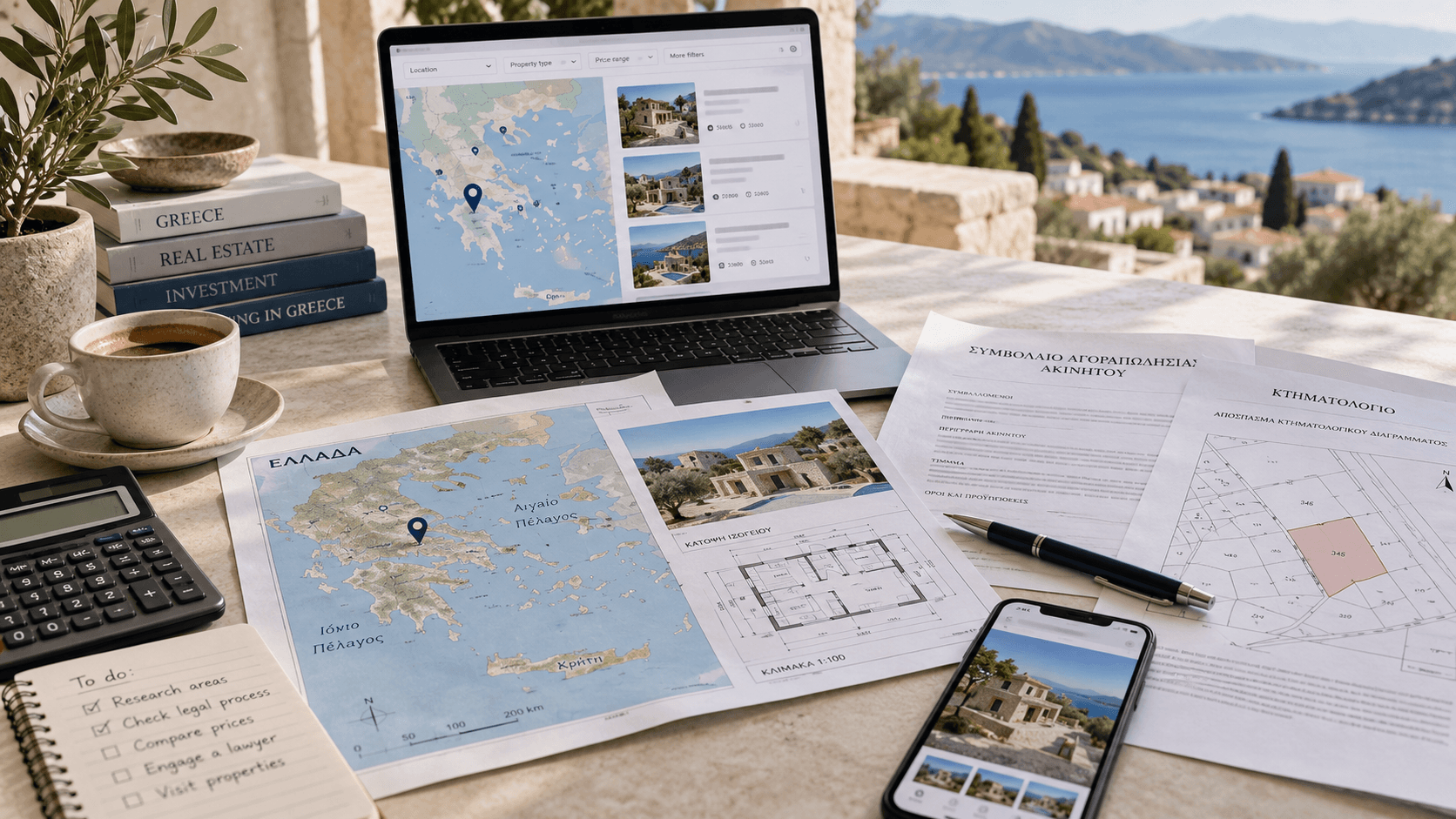
Can foreigners buy property in Greece?
In general, yes.
Foreign individuals can buy residential property in Greece. However, buyers from outside the EU and EFTA need to pay particular attention to properties located in certain areas classified under Greek law as border or near-border regions. Acquisition in those areas can require prior authorisation. Specialist legal sources trace these restrictions to Articles 25 and 26 of Law 1892/1990, as amended. Source: Athens Law Office.
This does not mean that every non-EU buyer needs special permission to buy anywhere in Greece. It means that buyer nationality and the exact location of the property should be checked before the buyer assumes the transaction can proceed normally.
if you are a non-EU/EFTA buyer, confirm whether the specific property falls inside a restricted area before making a binding commitment.
Before making an offer, understand what you are actually looking at.
A property listing is the beginning of the investigation, not the end. At the viewing stage you usually know the seller's asking price, the advertised floor area, the location, photographs, a description of the property and whatever information the seller or agent has supplied.
None of those things, by themselves, prove that the seller holds clean title, the physical layout matches the legal records, alterations are lawful, the advertised area matches the relevant documents, no mortgage or other encumbrance exists, or the asking price is supported by nearby transaction evidence.
A buyer actually needs to ask several separate questions: Is the ownership legally clear? Does the building match its legal and technical records? What has actually sold nearby? What taxes and transaction costs apply? Are there restrictions specific to this buyer or location?
Different evidence answers each of those questions.
Get a Greek tax identification number before the purchase.
A foreign buyer needs a Greek tax identification number, commonly referred to as an AFM (ΑΦΜ), before purchasing property.
AADE, the Greek Independent Authority for Public Revenue, states that someone living either in Greece or abroad must obtain a Greek tax number and submit the relevant property-transfer tax declaration before buying property. Source: AADE.
The AFM becomes part of your financial and tax identity in Greece. It is used not only during the acquisition but also for later property-tax and reporting obligations.
the AFM is not paperwork to leave until the day of signing. It is one of the administrative prerequisites that should be organised early in the process.
Do you need a Greek bank account?
A Greek bank account can be useful, but it should not automatically be described as a universal legal requirement for buying property.
PwC's guidance on Greek real-estate purchases states that opening a Greek bank account is not required by law, although it can be practically useful for paying transaction-related costs and fees. The same guidance notes that SEPA-country residents can, in relevant circumstances, make payments from a foreign account. Source: PwC Greece.
AADE also describes transfer-tax payment through credit institutions and other payment methods rather than stating that ownership of a Greek bank account is itself a statutory prerequisite. Source: AADE.
separate the question “Would a Greek bank account make this transaction easier?” from “Does Greek law always require me to have one?” They are not the same question.
Build the buyer-side professional team.
Several professionals can appear in a Greek property transaction, but they do different jobs. A notary is part of the formal transfer process, but that does not make the notary the buyer's independent legal adviser. A civil engineer can identify technical or planning issues, but does not replace legal title review. An estate agent can help bring the buyer and seller together, but does not replace either legal or technical due diligence.
| Professional | Main role for the buyer |
|---|---|
| Lawyer | Legal/title review and protection of the buyer's legal interests |
| Civil engineer | Technical, planning and building-compliance review |
| Notary | Formal preparation and execution of the notarial transfer deed |
| Accountant / tax adviser | Tax registration and ongoing tax compliance where needed |
| Estate agent | Property search and transaction intermediation |

Is a lawyer legally required?
Not as a general requirement for executing the sale deed. A Greek law firm states that, since 1 January 2014, the presence of a lawyer when drafting and executing a real-estate transfer contract is optional for both buyer and seller. Source: Koraki Law.
That is different from saying a lawyer is unnecessary. For a foreign buyer, independent legal review is one of the main ways to investigate ownership, registrations, encumbrances and transaction terms before money is committed.
distinguish between what the law forces you to appoint and what prudent buyer-side due diligence requires.
Before paying a deposit, know what has — and has not — been checked.
A deposit can feel like the first administrative step in buying a property. In reality, it may be the first point at which the buyer takes financial risk.
Before paying one, understand what document you are signing, whether the payment is refundable, what conditions apply, what happens if legal or technical due diligence reveals a problem, what happens if financing or another buyer condition fails, and what has actually been checked at that point.
A reservation agreement, private agreement or deposit does not itself prove that the property's title or technical status is clean. The exact legal effect depends on the document and circumstances, so this is an area where the buyer's lawyer should review the proposed terms before a binding commitment.
do not confuse “the seller accepted my offer” with “the property has passed due diligence.” They are separate stages.
Legal due diligence and technical due diligence answer different questions.
This is one of the most important distinctions in the Greek buying process.
Legal review
The buyer's lawyer may investigate ownership and chain of title, registered mortgages, liens or other encumbrances, claims or restrictions, cadastral records and the terms of the transaction.
Technical review
A competent engineer may investigate the building permit, approved plans, whether the actual property matches those plans, unauthorised construction or alterations, building legality, and issues affecting land or development potential.
PwC's guidance makes the same distinction: legal advisers address ownership and encumbrances, while civil engineers review matters such as building permits and the physical characteristics of the property. Source: PwC Greece.
A property can have clean title and still have a technical problem. A technically sound building can still have a legal ownership or registration issue.
when someone says a property has been “checked”, ask exactly what was checked, by whom, and against which records.
Understand the full purchase cost before the final deed.
The asking price is not the full acquisition cost. Depending on the transaction, additional costs can include property transfer tax, notary fees, registration or cadastral charges, lawyer fees, engineer fees, estate-agent commission where applicable, tax/accounting support, translation or power-of-attorney costs, and other transaction-specific expenses.
Some of these costs are statutory. Others are negotiated professional fees. There is no single percentage that accurately describes the cost of every Greek property purchase.
Property transfer tax
AADE states that real-estate transfer tax is paid by the buyer and that the standard tax rate is 3% of the taxable value. The main tax is also subject to a municipal levy equal to 3% of the tax itself. Source: AADE.
This is why the ordinary effective figure is commonly described as 3.09% of the relevant tax base. But that does not mean every transaction can simply be calculated as purchase price × 3.09%. Exemptions and different tax treatments can apply, and the relevant tax base needs to be established correctly.
build the transaction budget from its individual components rather than relying on a generic “add 10%” rule.
The transfer tax is dealt with before the final transfer contract.
AADE states that the parties must file the real-estate transfer tax declaration and the tax must be paid before the transfer contract is drawn up. The buyer is responsible for the transfer tax. Many transfer-tax declarations are now submitted digitally through the myPROPERTY system. Source: AADE.
The notarial deed is the formal transfer stage.
Greek property purchases require a notarial deed. PwC notes that real-estate transactions are executed before a notary public, with the notarial deed being the formal legal instrument used in the transaction. Source: PwC Greece.
By the time you reach final signing, the buyer should already understand the results of the relevant legal and technical checks. Completion is the end of the verification process, not the beginning of it.
Ownership also needs to be registered.
Signing the deed is a critical step, but the transfer process also involves registration with the competent land-registration or cadastral system. Your lawyer and notary can confirm the exact registration process applicable to the property.
What happens after you buy?
Buying the property creates continuing tax and administrative obligations.
AADE states that foreign residents, just like Greek residents, are required to submit a Real Estate Statement (E9) following the acquisition of Greek property. In transactions submitted digitally through myPROPERTY, the E9 can in some cases be generated automatically. The information in E9 is also used in the calculation of ENFIA, Greece's annual property-ownership tax. Source: AADE.
After completion, retain an organised copy of the purchase deed, registration evidence, tax documents, technical documents, relevant plans and professional reports obtained during the purchase.
completion does not end your interaction with the Greek tax and property systems. It changes you from buyer to owner.
Can you buy a Greek property remotely?
Often, yes. A properly structured power of attorney can allow another person to carry out specific steps or sign on the buyer's behalf.
Specialist legal guidance notes that a party can be represented at the notarial transaction through an appropriately drafted special power of attorney. Source: Greece Lawyer.
The wording and formalities matter. A generic power of attorney created for another purpose should not automatically be assumed sufficient for a Greek property transaction.
remote purchase is possible, but the authority given to the representative should be designed around the specific transaction.
How long does buying property in Greece take?
There is no responsible single answer. The timeline depends on whether the buyer already has an AFM, how quickly documents are available, complexity of the property's title, cadastral status, technical irregularities, seller readiness, tax administration, financing, whether a power of attorney is needed, whether special foreign-buyer permission applies, and how quickly problems identified during due diligence can be resolved.
Older industry guidance sometimes gives approximate transaction windows of a few months, but these should not be treated as promises for a specific property. A clean apartment with complete records is not the same transaction as rural land with boundary, forest, planning or title questions.
ask what is currently blocking your transaction rather than relying on an average completion time.
Golden Visa eligibility is a separate question from whether a property can be bought.
For non-EU buyers, a property purchase may also be connected to residence planning. But these are two different decisions:
- Can I legally and safely buy this property?
- Does this purchase meet the current requirements of the residence route I want to use?
Do not assume that because a property can legally be purchased, it automatically qualifies for a Golden Visa. Residence rules, investment thresholds and qualifying categories have changed over time and should be verified against the current rules before the buyer structures the purchase around them.
investigate residence eligibility before committing to a property whose purpose depends on that eligibility.
The buying process at a glance.
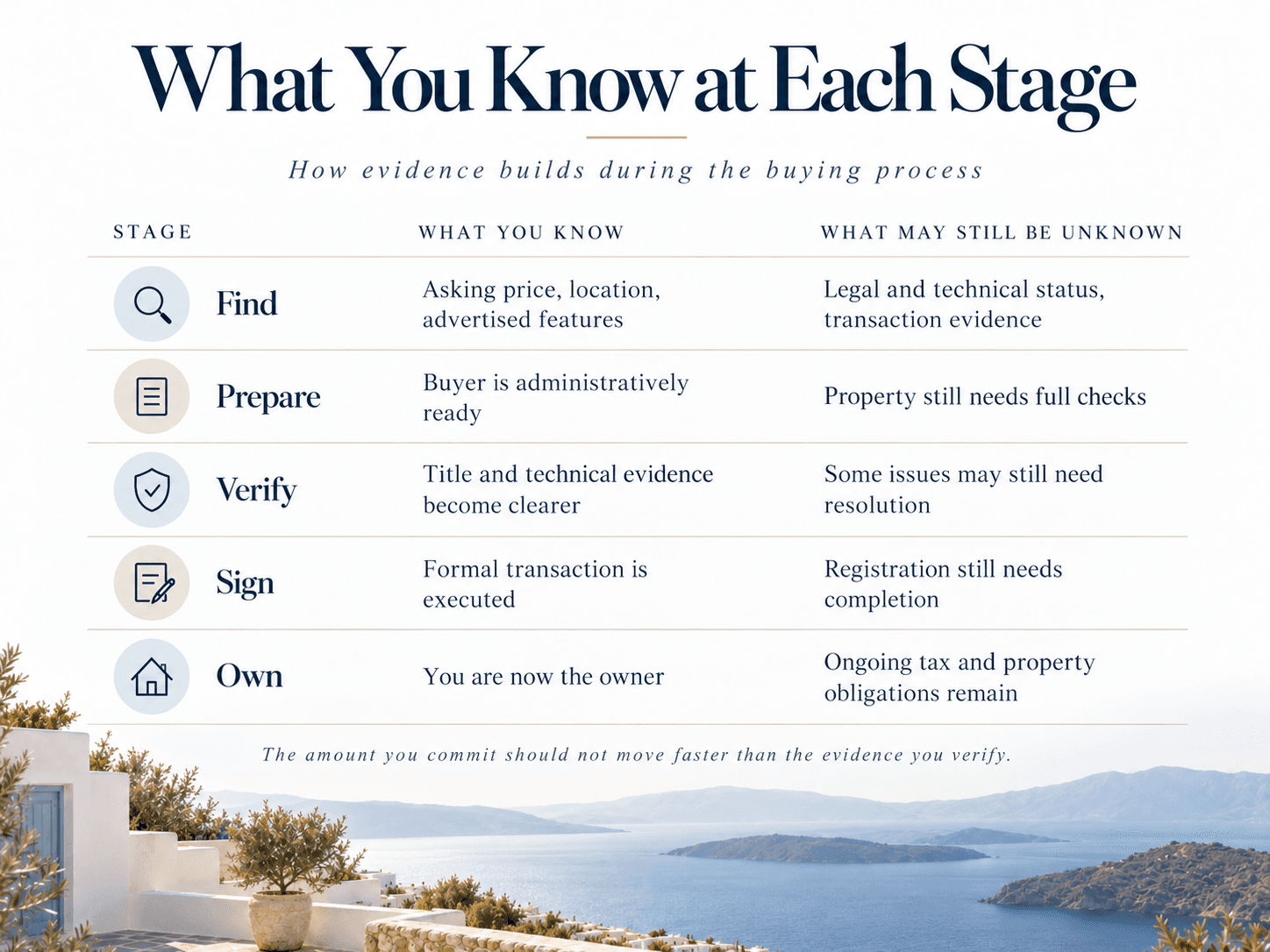
The process is easier to understand when you separate what happens from what you actually know at each stage.

| Stage | What happens | What you know | What may still be unknown |
|---|---|---|---|
| Find | You identify a property | Asking price, location, advertised characteristics | Legal/technical status, transaction evidence |
| Understand | You collect basic property and market context | What is being offered | Whether claims match records |
| Prepare | AFM, advisers and transaction setup | Buyer is administratively ready | Property may still require full checks |
| Verify | Legal and technical due diligence | Title and technical evidence become clearer | Issues may still need resolution |
| Commit | Deposit/private agreement where used | Commercial terms may be agreed | Depends on conditions written into agreement |
| Tax | Transfer-tax process | Relevant tax treatment becomes part of completion | Other ownership costs continue after purchase |
| Sign | Notarial deed | Formal transaction is executed | Registration still needs completion |
| Register | Deed entered in the relevant property registry/cadastre | Ownership transfer is formally recorded | Ongoing owner obligations remain |
| Own | E9/ENFIA and property administration | You are now the owner | Future tax, maintenance and use obligations |
The amount of money you commit should not move faster than the amount of evidence you have verified.
What this guide cannot tell you.
A general buying guide cannot tell you whether a specific Greek property has clean title, is free from liens, matches its cadastral records, complies with its building permit, contains unauthorised alterations, is worth its asking price, qualifies for a specific residence programme, or is the right purchase for you.
Those questions require property-specific evidence and, where appropriate, qualified professional review.
A lack of a visible problem is not proof that no problem exists. And a clean legal or technical review does not by itself tell you whether the asking price is supported by the market evidence.
Common questions.
Do foreigners need to live in Greece to buy property?
No. Living in Greece is not a general prerequisite for purchasing Greek residential property. Foreign buyers still need to satisfy the administrative and transaction requirements that apply to the purchase, and non-EU/EFTA buyers should verify whether the specific property's location triggers restricted-area rules.
Is a lawyer mandatory when buying property in Greece?
A lawyer is not generally mandatory for execution of the property sale deed, but this should not be confused with legal due diligence. An independent lawyer can investigate title, registrations, encumbrances and transaction terms on behalf of the buyer.
Is a Greek bank account mandatory?
Not as a universal legal requirement. It can still be useful or practically necessary depending on the payments, bank arrangements and transaction structure.
When should due diligence happen?
Before the buyer makes a financial or contractual commitment that assumes the property is legally and technically acceptable. The exact timing depends on the transaction, but due diligence should not be treated as something to begin only after final signing.
Does the notary replace the buyer's lawyer?
No. The notary performs the formal public role required for the transfer. The buyer's lawyer, where appointed, represents and advises the buyer's interests.
Found a property already?
A general guide can explain the process. A specific purchase requires specific evidence.
Before you rely on the asking price or commit serious money, check what the available transaction, market, tax and property evidence actually says about the property you are considering.